Google finds AI agent writing and launching exploits with no human in the loop
Threat actors have started letting AI agents carry out whole stages of live intrusions, and at least one operation no longer needs a human to turn a newly released patch into a working attack, Google Threat Intelligence Group (GTIG) and Mandiant revealed.
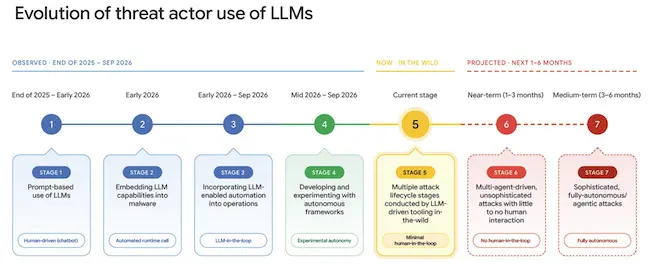
LLM maturity timeline (Source: Google)
“While the mechanics of the intrusions remain the same, such as using compromised credentials and targeting unpatched systems, the speed and scale at which frameworks can exploit these known weaknesses introduces a new defensive challenge,” Google wrote.
Pentesting tools turned against victims
Google’s analysts saw several threat actors use open source agentic pentesting frameworks during intrusions. ARTEX has drawn the most attention, prompting a response from the FBI. In a FLASH alert issued on November 13, the bureau warned that since at least August 2026, actors have used it against organizations in financial services, government, technology, defense, healthcare, energy, and other sectors.
Attackers are also running CAIRN, CyberStrikeAI, PentAGI and HexStrike AI, and some have experimented with harnesses they built themselves. The tools can find and exploit simple vulnerabilities and change tactics based on what comes back from the target.
Groups experimenting with these tools include financially motivated threat actors and suspected China-nexus espionage outfits, and GTIG found evidence that one PRC-nexus group was building its own automated attack framework, likely for espionage.
At this stage the frameworks “trade stealth for velocity,” GTIG notes, and leave behind traffic and code traces that make them easier to catch.
“As the sophistication of these tools and underlying LLMs increases, we anticipate not only reduced human involvement in these operations but also increased stealth and sophistication of the activity,” researchers said.
Exploits written and launched with no one at the keyboard
In the past quarter, GTIG says it saw threat actors use LLM frameworks to automate vulnerability discovery and exploitation “without a human in the loop for the first time.”
The evidence came from an exposed staging server hosting a multi-agent framework called exploit_agent, connected to several frontier and local LLMs. The setup compares the code of popular web applications before and after patch announcements, looks for the flaw, drafts an exploit and runs it.
Alongside data stolen from victims, the server held scripts for brute-forcing, installing webshells and removing webshells planted by other attackers. Comments in a configuration file were written in Russian, with one labeling the LLM API keys as being “for auto-exploitation (exploit_agent pilot).” Victim telemetry suggests the operator was interested in French websites tied to media, entertainment and education.
GTIG’s September analysis of vulnerability data found that disclosures and exploits nearly doubled between January and August 2026, and zero-day exploits jumped to 22 in August, up from a 2025 average of 8 a month.
Defenders also have to deal with a flood of “LLM-generated exploits that are claimed to work but don’t.” After official patches for two PHP flaws (CVE-2026-109618 and CVE-2026-109619) landed on October 21, hundreds of non-functional proofs of concept appeared online, and the security community had to check each one.
Stolen AI access for sale
Mandiant responded to several LLMJacking incidents in 2026, in which attackers broke into cloud environments to burn through the victim’s compute and LLM quotas. Fraudulent charges in some cases passed $100,000 in a single day, and in the worst ones the total reached $1 million before the abuse was stopped.
In one case, a botnet using leaked credentials “generated millions of LLM API calls in approximately 24 hours before the credentials were revoked.” The stolen access is resold through what GTIG calls “LLM Mixers,” underground storefronts that offer frontier and jailbroken models for between $0.10 and $25 per million tokens.
A coding assistant used to drop a backdoor
For North Korea’s fake IT workers, LLM tools have turned into a job-hunting aid that writes their resumes and helps them sound authentic in interviews with Western companies.
GTIG has seen North Korean tactics change over the course of 2026, with AI used to break into the companies themselves. In attacks on cryptocurrency organizations in North America and Europe, a suspected cluster tracked as MIDNIGHT NEPTUNE set up fraudulent recruiter profiles whose photos carried SynthID watermarks, confirming they were AI-generated. The fake recruiters steered targets to bogus meeting platforms with ClickFix lures that got them to run “diagnostic” scripts.
After getting in, the attackers moved into internal code repositories and changed .claude/settings.json files so that launching Claude Code “would automatically trigger the download of the SOMBERMEME backdoor.” To blend in during lateral movement, they named the GitHub Personal Access Tokens they generated after Microsoft Copilot.
Fake personas built to look human
GTIG assesses with high confidence that influence operation actors have gone from testing LLMs to using them routinely. In August 2026 it investigated a platform built to automate whole influence campaigns on regional political topics in Europe and the Middle East. Its prompts asked models to copy local dialects and slang and to add “intentional typos to avoid sounding like an automated tool,” while generated images were given grain and uneven lighting to pass as smartphone photos.
A separate contractor was building a platform to run more than 100,000 accounts through cloud phone farms. New accounts went through an automated “aging” period, with LLMs simulating ordinary scrolling and browsing before the accounts started pushing campaign messages. Prompts showed the contractor planned to sell the tool to its own government and to foreign clients.
“Threat actor adoption of these frameworks represents a paradigm shift towards intrusions occurring at machine speed, with the automated chaining of complex attack paths scaling operations significantly,” researchers concluded.