Companies going all in on AI could see their strategy backfire
Four of the five highest-ranked enterprise risks in Gartner’s Quarterly Emerging Risk Report were AI-related. AI strategy miscalculation and AI-driven competitive displacement debuted at No. 3 and No. 4, respectively. The AI workforce preparedness gap held fifth place.
AI discovery of cyber vulnerabilities and geopolitical energy supply shocks held the top two spots for the second consecutive quarter. The rankings show a composite risk score based on responses from 308 enterprise risk management leaders, auditors and senior executives.
Why AI strategy miscalculation matters
Organizations can miscalculate when they make major strategic, operational or workforce decisions based on AI benefits that take longer to materialize, fall short in scale or deliver less economic value than expected.
Pressure to keep up with rivals can prompt companies to commit resources before they understand what a project can deliver or whether their teams are ready to implement it. Projects that fall short can divert money and staff time from other priorities.
“Organizations risk pursuing AI initiatives without sufficiently testing whether the use case aligns with business priorities, risk tolerance, available capabilities and expected returns,” said Kevin Mercado, Senior Principal Analyst, Research, in the Gartner Risk & Audit Practice.
Cyber vulnerabilities and energy shocks hold the top spots
AI could help attackers discover and exploit previously unknown software flaws faster than security teams can assess, prioritize and fix them. A growing backlog could leave sensitive data and intellectual property exposed for longer and drive up remediation costs.
Geopolitical conflict, sanctions and damage to infrastructure can disrupt energy production and shipments, raising energy and transportation costs. Businesses that rely on steady energy supplies may have to delay operations or cut production.
The other two AI risks in the top five concern competition and workforce readiness. Companies whose AI projects remain stuck in pilots could lose customers to rivals that use AI to offer better services or lower prices. Within companies, job requirements can change faster than employees can build the skills they need. Gaps in training and guidance can lead to uneven adoption and lower returns on AI investments.
How organizations track AI risk and measure returns
In Gartner’s 2025 survey of 225 senior risk and assurance leaders, 54% said their organizations documented AI both as a standalone entry in their risk registers and within other risk entries. The share that tracked AI only as a standalone risk fell from 36% in 2024 to 23% in 2025.
Earlier editions of the emerging risk report covered AI-assisted attacks, employee misuse and intellectual property control. The latest edition also examines which AI investments companies make and how they respond to competitors’ use of the technology.
Three separate 2026 Gartner surveys show how finance leaders, board members and audit committees view technology risk and AI returns. In the CFO survey, 17% said more than half of their AI projects had delivered measurable revenue growth or cost savings. In the board survey, 64% said organizations should take greater technology risk to deliver shareholder value. In the audit committee survey, 43% expected an audit of AI strategy in the coming year.
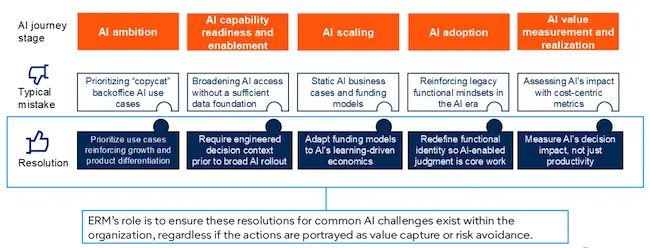
Strategic AI action plans can manage risk and create value (Source: Gartner)
Companies should clarify who oversees their AI strategy and who puts it into practice. They should also assess how each initiative will affect other priorities and resources, and decide how to measure its return. When AI saves employees time, companies should track how employees use that time and whether it translates into measurable productivity gains.
“Organizations should evaluate AI as a portfolio of business decisions,” Mercado added. “The organizations most likely to realize sustained value will connect AI investments to clear business outcomes, validate readiness before scaling and establish governance that supports responsible experimentation.”