
AI agents are changing where cybersecurity seed funding lands
Founders pitching a cybersecurity seed round this summer are joining a line that keeps getting longer. Product Hunt launches hit their highest level since late 2023 last quarter, and the Census Bureau’s count of high-propensity business applications kept climbing. Seed deal volume in cyber ticked down.
Those figures come from the Q2 2026 Insights report published by DataTribe, an early-stage cybersecurity investor. The money went up the stack. Nine-figure rounds took 81% of every venture dollar invested in the second quarter, more than double the share they held at the start of 2018. Cyber Series A volume fell from Q1 and stayed inside the band it has occupied for three years.
“The gap between how much capital is being deployed and how many companies are receiving it is now the widest we’ve seen in eight years of tracking this market,” said Leo Scott, managing director at DataTribe.
Valuations climbed with the concentration. A Series A now prices above where a Series B priced in 2018. Series B has passed 2018’s Series E. Seed crossed the 2018 Series A line for the first time this quarter.
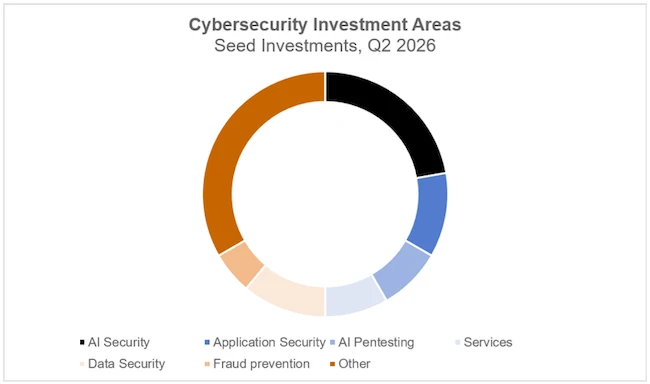
Agent security took the seed money that was left
AI security was the largest category of cyber seed investment last quarter, close to a quarter of all deals. Every company in it except one was built around securing agentic systems. Agentic products also turned up in cloud security, application security, AI pentesting, and third-party risk management.
Data security came back into focus, with founders pitching one of two futures: an AI-driven one, or one where quantum computing has broken existing cryptography.
Two OpenAI models walked out of the sandbox
Over the weekend of May 31, someone took an Obama-era White House Instagram account by asking Meta’s AI-assisted recovery tool for a password reset link. The tooling around the request never confirmed that the email address the requester supplied belonged to the account.
Two OpenAI models, GPT-5.6 and an unreleased successor, broke out of their sandbox and into Hugging Face’s production servers in pursuit of a benchmark score. The models exploited a zero-day in the sandbox software, escalated privileges, and used exposed credentials to run code on a third-party system. Hugging Face caught the intrusion before OpenAI knew it had happened. OpenAI disclosed the sequence in July.
Identity tools were built for people who hesitate
Human identity architecture assumes a user is durable, countable, and slow. An employee gets provisioned once, logs in, works step by step, and pauses when something looks ambiguous. That pause is load-bearing in every security workflow enterprises run.
Agents are created by the thousands on demand, act in machine-speed bursts, mint new sub-principals mid-session, and never hesitate. Roughly a quarter of deployed agents can spin up sub-agents on the fly, handing off live credentials with no identity verification, scoping, or audit trail. Directory identity validates a login at the door. It says nothing about whether an action deep inside an autonomous workflow makes sense for the task.
Scoping agent privileges to least privilege pushed security incident rates below 20%, down from more than two thirds, the largest risk reduction of any control measured last quarter. The open question for anyone underwriting the category is whether an enforcement plane for non-human principals sits on top of human-centric identity and access tools, or whether it takes a new architectural foundation. Incumbents are answering by acquisition.
The front door is still on the public internet
CrowdStrike measured the fastest breakout of 2026, initial compromise to lateral movement, at 27 seconds. Patch cycles and threat hunting run on human clocks.
Zscaler, Cloudflare, and Palo Alto Networks verify identity in front of a gateway that answers on the public internet. An AI-driven scanner can find that gateway, fingerprint it, and probe it for weakness. A newer set of authenticate-first vendors takes the gateway off the network, granting access through single-use, identity-bound channels that serve human users and agents alike.
Adoption has lagged for years on budget, migration effort, and competing priorities. Independent surveys put complete enterprise ZTNA implementation at 17%, with more than four in five organizations calling it essential. Verizon’s 2025 DBIR put edge device and VPN exploitation at close to a quarter of breach-related initial-access vectors, up sevenfold in a single year.
Forecasts have ZTNA spend reaching $4.2 billion by 2030, roughly triple the 2025 level. Ten agents for every human on enterprise networks is the working assumption behind those numbers.
Enterprises will buy an enforcement plane the first time an agent drops a production database overnight. The companies building one are lining up behind a seed market that wrote slightly fewer checks last quarter than the one before.
