
Google Colab CLI opens runtimes to Claude Code and Codex
Google released the Google Colab Command-Line Interface, a tool that connects local terminals to remote Colab runtimes. The CLI provides an execution platform for developers and AI agents, letting users provision compute, run local Python scripts on remote runtimes, and retrieve artifacts back to local machines.
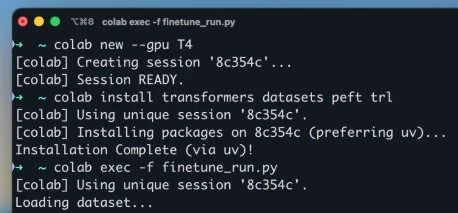
Google Colab CLI (Source: Google)
Commands and accelerator options
The CLI handles GPU and TPU provisioning through commands such as colab --gpu A100 and colab --gpu T4. The colab exec command runs local scripts on a remote runtime. The colab download and colab log commands retrieve models, datasets, and replayable .ipynb logs. Interactive sessions are available through colab repl and colab console.
Agent integration
The CLI integrates with standard terminal environments and can be used by any AI agent with terminal access. The package ships with a prepackaged skill file named COLAB_SKILL.md that gives agents the context needed to operate the CLI. The tool can be used by Antigravity, Claude Code, Codex, and other agents.
Example workflow with Gemma 3-1B
The release includes a demonstration of a QLoRA fine-tuning pipeline for the google/gemma-3-1b-it model on a Text-to-SQL dataset hosted on Hugging Face. The example uses the Antigravity agent, which executes the following sequence:
colab new --gpu T4

colab install transformers datasets peft trl bitsandbytes accelerate

colab exec -f finetune_run.py

colab log --output gemma_finetune_log.ipynb

colab stop
The agent then uses colab download to retrieve the adapter model, adapter config, tokenizer config, and tokenizer files, producing a fine-tuned model that can be loaded and served locally.
Availability
Setup instructions and source code for the Colab CLI are hosted on GitHub.

Must read:
- 25 open-source cybersecurity tools that don’t care about your budget
- GitHub CISO on security strategy and collaborating with the open-source community

Subscribe to the Help Net Security ad-free monthly newsletter to stay informed on the essential open-source cybersecurity tools. Subscribe here!